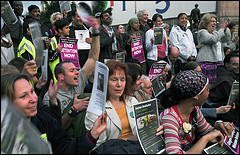
DEFEND LEGAL AID AND OUR ACCESS TO JUSTICE

“If you start cutting legal aid you start cutting people off from justice … And that’s dangerous … You may get them taking the law into their own hands.”

Lord Neuberger, the UK’s most senior Judge.

More cuts in legal aid are on the way unless we stop them. Cuts already passed include: the end of legal aid for most immigration, welfare benefits, housing, child custody, clinical negligence, employment, housing, debt and education.

Cuts to legal aid disproportionately affect women and people of colour including because our incomes are generally lower than white men’s.  Women carry a disproportionate burden of justice work.  As victims of rape and domestic violence we fight to get injunctions and to challenge police and CPS decisions not to prosecute our attackers.  But we are also on the front line defending loved ones.  Women of colour, who must deal with the disastrous personal and social effects of racism, carry a particular burden.

“While it is public knowledge that people of colour, and particularly young men of colour, are   regularly harassed, falsely arrested and beaten by the police, there is rarely a mention of the women – mothers and sisters, wives and lovers – who go back and forth to courts and prisons, who organise defence committees and attend their meetings sometimes on winter nights after long days cleaning hospitals; or who deliver to prison cells, along with home cooking and cigarettes (and at times unwelcome words of advice), the laundered shirts, so that the accused – son, brother, husband or lover – can appear before his persecutors dressed in the community’s care and support.”(Sex, Race and Class: The Perspective of Winning, Selma James, 2012 p.178-9)

Some of the proposals target immigrant people.  But we can be sure that if the government gets away with this, the same policies can, at any time, be extended to everyone. Asylum seekers were the first to have benefits replaced with vouchers, and be dispersed out of London – now everyone is at risk.

The proposed changes mean that:

·         Solicitors will have to bid for criminal cases and the lowest bidder will get appointed, not the lawyer of your choice, regardless of experience or lack of it.  About 75% of lawyers now doing legal aid work will no longer be able to; the 25% left will have a lot less time to spend on cases. The quality of representation (sometimes already bad) will get even worse and it will no longer be possible to get help from a firm that specializes in a particular area of law – for example, if you are arrested whilst protesting.  (Some corporations who are likely to bid for legal work, like G4S, are already running prisons and deporting people so have a vested interest in people being convicted and imprisoned.  Protests against G4S, for the death of JimmyMubenga and other atrocities, are demanding that the corporation be barred from public service work.  Others like trucking company Eddie Stobart have no legal experience at all.)

·         It will be harder, in most cases impossible, to make an application for Judicial Review (JR). Legal aid will now only be available if a judge grants permission.  None of the preparation work to convince the court you need a JR will be funded.  Legal firms will have to cover these costs in the hope that legal aid will later be granted – many will be put off from taking cases. JRs are a crucial way you can challenge decisions of the state – the police, the Ministry of Justice, the Crown Prosecution Service, the Independent Police Complaint Commission, UKBA, local authorities, etc.  While very senior lawyers represent the government in JRs, and their fees aren’t being cut, most victims of state violence and illegality will be unable to afford any lawyer.

·         Prisoners will have no right to a lawyer to help them with many of the problems they face inside jail, even if what the prison has done is illegal and even if it means being imprisoned for longer.  If you are in prison you won’t be able to get legal help to access rehabilitation courses, challenge bullying and violence from guards, how you are categorized (A, B, etc.) or being held in solitary; yet a wrong categorization and solitary can add years to a sentence and seriously affect your health.  There are no exemptions, not even for children, disabled or mentally ill prisoners.  Prisoners will be expected to represent themselves, without any outside legal help, through an notoriously unjust prison complaint system, against the very people who are persecuting them. Reprisals are already common against “jailhouse lawyers”. Forty percent of prisoners face additional discrimination because of low literacy skills.

·         People who have not been in the UK lawfully for at least 12 months won’t get legal aid for any civil action.  Only people with current asylum claims will qualify.  If your asylum claim is refused or you don’t have settled legal status, you won’t be entitled to civil legal aid – even if you have compelling evidence of rape or other torture, or have lived in the UK for years.  No matter what happens to you – you are made homeless, assaulted by the police, detained, you need to apply for bail or to challenge illegal detention – there’s no legal aid for you.  Only the rich will be able to afford legal action. Family members of people killed by the authorities won’t get legal aid for representation at the inquest if they fail the residence test.  A woman recently arrived as a spouse in the UK who suffers domestic violence will not be entitled to legal aid to apply for an injunction.

·         Secret courts without a lawyer – in the UK!  If you are suspected of (unproven) links with ‘terrorism’ or other ‘national security’ issues, you will face deportation proceedings in a special court which can use secret evidence which is not shown to you.  If you fail the residence test you will not receive legal aid.

·         Fees are being cut for experts providing medical and psychological reports, which are often crucial togetting justice.  Fewer experts will be ready to do legal aid work and the quality of the reports may suffer. Black Women’s Rape Action Project and Women Against Rape found that women with expert reports corroborating the evidence in their asylum claim were six times more likely to win on appeal.

TAKE ACTION

1.  Sign the petitionhttp://epetitions.direct.gov.uk/petitions/48628

  1. Write to your local paper/member of parliament to say how you will be affected.  Have you ever challenged a housing or benefit or child custody decision?  Have you ever challenged youtreatment by the police, the Crown Prosecution Service, the IPPC?  Have you ever challenged detention or your treatment inside prison?  Have you ever had to change lawyers because your lawyer was no good?  What would have happened if you hadn’t been able to get or change lawyers?

3.  Check out Save UK Justice website and this blog: http://savelegalaid.wordpress.com/where you can submit your story.

Comments Off on DEFEND LEGAL AID AND OUR ACCESS TO JUSTICE

14 October 2013 · 9:48 am

PRISONERS ARE ENTITLED TO THE VOTE

When MPs consider prisoners’ right to vote they should have in mind who prisoners are, and how many should never even have been locked up.

Two thirds of women in British prisons are there for non-violent offences. Most are inside for fewer than six months for shoplifting, non-payment of fines, benefit fraud, and offences linked to drug addiction and sex work.  A quarter had no previous convictions.

Over half are mothers.  Every year 17,000 children are deprived of their mothers by prison, which Baroness Corston has described as “often nothing short of catastrophic”.

Over half are themselves victims of violence and one in three has experienced sexual abuse.  Some, like Layla Ibrahim and Gail Sherwood, are rape victims who were disbelieved and are campaigning to clear their name.  Verna Joseph, raped by a gang who threatened to kill her and her daughter if she didn’t bring drugs into Britain commented: “I was sentenced to nine years while my attackers were never arrested.” Women prisoners are subjected to “excessively punitive” treatment that many of us would consider criminal torture.  How else do we describe “separation visits” in a prison main visiting hall where mothers say farewell to their children before they are taken for adoption?  
Black people are 14% of those in prison but only 2% of the overall population. Young Muslims protesting Israel’s bombing of Gaza in 2008-9, and people convicted in the 2011 rebellions that followed the police shooting of Mark Duggan, received significantly harsher sentences than standard. How much are these disparities due to discrimination against people of colour and working class people, especially when they are protestors? Recently released Ben Gunn served many years over his tariff because he fought for prisoners’ rights.  He comments: “Prisoners are part of society, and the treatment we receive is part of society’s standards of in/humanity.  Why shouldn’t we have a say?” Daniel Roque Hall, a severely disabled man nearly died after only seven weeks in prison; he is still in hospital fighting not to be sent back to conditions which amount to a death sentence.
Scores of women self-harm and take their own lives while in prison.  Pauline Campbell, mother of Sarah, one of six women who died in Styal prison in one year, was arrested numerous times for protesting at prison deaths: “The unjust sentencing of vulnerable women; their suffering, and deaths – that is the injustice.  [The] Justice Secretary is the one who should be in the dock, not me.”
One hundred and fifty thousand people in the UK go through prison each year, many more are ex-prisoners, or related to people who are or have been inside.  Cameron said he felt “physically sick” at prisoners gaining the right to vote, and most MPs went along with him.  How sick to dismiss such a large and vulnerable proportion of the population!   Some of the worst criminals have never been locked up: from MPs stealing “expenses”, to bankers and corporations defrauding taxpayers, and prime ministers who should be tried for war crimes.  Should they vote?


Contact: Niki Adams

Legal Action for Women

Crossroads Women’s Centre

25 Wolsey Mews

Kentish Town

London, NW5 2DX

020 7482 2496

07956 316 899

21 November 2012

Leave a Comment

Filed under Prison

Prisoner’s rights: Mumia Abu-Jamal

Mumia Abu-Jamal is an award-winning journalist who, in the years leading up to his arrest, actively exposed corruption and racism in Philadelphia.  He was convicted in 1982 of killing a policeman in a trial drenched in racism: while Philadelphia was 43% Black, only two jurors were African-American.  Throughout almost three decades on death row, Mumia Abu-Jamal has consistently fought against injustice and for his freedom.

A new book from death row

Mumia Abu-Jamal

JAILHOUSE LAWYERS:

PRISONERS DEFENDING PRISONERS V THE USA

Foreword by Angela Y. Davis
Introduction to UK edition by Selma James

Published by Crossroads Books

From death row, award-winning journalist Mumia Abu-Jamal introduces us to fellow prisoners who litigate against their jailers, risking punishment or even death, to win justice for themselves and other prisoners. 

“This is the story,” he writes, “of law learned not in the ivory towers of multi-billion-dollar endowed universities [but] in the hidden, dank dungeons of America – the Prisonhouse of Nations.”

Selma James’s Introduction presents the parallel universe of UK jailhouse lawyers who, like their US counterparts, are leading a justice movement inside prisons.

UK prisoners, denied the vote, are campaigning for this fundamental right. A legal challenge brought by a jailhouse lawyer supported by a dedicated legal team won a European Court ruling in 2004 that a blanket ban on votes for prisoners violates their human rights. Yet the government, in opposing votes for prisoners, acts as if those of us who are prisoners are less human, and deny that prisons and what goes on in them also frame the kind of society we all inhabit.

The UK publication of Jailhouse Lawyers is an opportunity for prisoners’ campaign for the vote and other efforts for fundamental reforms to be more widely known and supported.


Click here to order

More information

Report from book launch in the House of Lords

Prisma Newspaper

Also in this section

Mumia case: appellate judges deliberate
Mumia’s response to the court ruling

Death Row journalist Mumia Abu-Jamal – The case for a new trial

pamphlet

LAW’s Niki Adams speaks about Mumia Abu-Jamal

Leading UK lawyers petition US Appeal Court protesting racism in Mumia Abu-Jamal’s case
Also available in French, German, Italian, Polish, Spanish

Voice article  Speech by Ian Macdonald

Journalists in support of Mumia: an open letter to the court

In Prison My Whole Life: a film about Mumia

Parliamentary showing

Exeter University showing

 LAW at the 3rd World Congress Against the Death Penalty (2007)

Doing the movement’s work from inside: an article by Selma James

Mumia in the media

Leave a Comment

Filed under Prison

Asylum rights

Launch of New & Updated Self-Help Guide
for Asylum Seekers and their Supporters

6pm Thursday 27 June 2013

Crossroads Women’s Centre, 25 Wolsey Mews London NW5 2DX

Speakers: Cristel Amiss, Black Women’s Rape Action Project; Maurine Mahoro, All African Women’s Group

Ronan Toal, Garden Court Chambers

 Self-help is crucial to winning asylum and immigration cases especially in the face of changes in the law and increased witch-hunts against immigrant people and legal aid cuts.  This Guide is needed more than ever at a time when thousands of people face being sent back to their country of origin, many of whom have suffered rape and other torture and persecution and/or have lived in the UK for years. 

Legal Action for Women T: 020 7482 2496 F: 020 7267 7297 Email: law[at]allwomencount.net

 Endorsed by: All African Women’s Group, Black Women’s Rape Action Project, Women Against Rape

EXTREMELY URGENT  
OPPOSE GOVERNMENT MOVES TO SCRAP the Human Rights Act
and defend everyone’s right to family life


27 June — launch of new & updated Self-Help Guide
For Asylum Seekers and their Supporters:
A Self-Help Guide against detention & deportation

This accessible step-by-step guide puts together information that is not usually available so that anyone determined to get protection and justice can find out how to do it.
Read more 

Review
Free to Asylum Seekers;
£2.50 other individuals; £5.00 organisations;
£10.00 professionals/institutions
+ p+p


A “Bleak House” for Our Times:  An investigation into Yarl’s Wood Removal Centre
by Legal Action for Women


New research based on the experiences of over 130 women detained in Yarl’s Wood Removal Centre explodes the myth that the asylum system is “fast but fair” and that most asylum seekers are “bogus”, and instead demonstrates that most of those deemed “bogus” have never had a chance to present their case.


£2.50 individuals; £5.00 organisations + p+p


Leave a Comment

Filed under Asylum

Victory for sex workers’ safety

9 April 2010 in Luton Crown Court Claire Finch was found not guilty of a criminal charge of keeping a brothel.  The jury, in line with public opinion, refused to criminalise Ms Finch for working together with friends from her own home for safety.  


This prosecution was motivated by a moral crusade and financial incentives for the police.  Since Proceeds of Crime legislation was introduced, police are able to keep any money resulting from raids.   


This not guilty verdict greatly strengthens the case for prostitution to be decriminalised so that women are able to work more safely together as in New Zealand.

. . ACTION ALERT . . . ACTION ALERT . . . ACTION ALERT . . .


Dear Friends,


Please can you write immediately to Sarah Brown, sarah.brown2@cps.gsi.gov.uk, at Luton Crown Prosecution Service, using the letter below to express your concerns about Ms F who is being prosecuted for brothel-keeping, an offence which carries a maximum sentence of seven years imprisonment.


Ms F is a mother and was working with four friends for safety.  She deliberately chose to work with more mature women because she said they were more able “to make their own minds up.  They’re not being hoodwinked


We enclose below our letter to the CPS with details of her case, asking for the prosecution to be dropped.  The CPS replied refusing andthe case is going ahead on 2 November.  


Please can you copy any letter you write to Nazir Afzal, Chief Prosecutor for London, nazir.afzal@cps.gsi.gov.uk, and to ourselves.   


Working with the English Collective of Prostitutes, LAW has successfully pressed for prosecutions to be dropped against women, often in a similar situation as Ms F, and sometimes at the last minute in court.  We hope we can have the same impact this time and prevent another woman’s life being blighted by a criminal record and possible prison sentence.


Many thanks,


Niki Adams


Legal Action for Women

Crossroads Women’s Centre  PO Box 287  London NW6 5QU

Tel: 020 7482 2496 minicom/voice  Fax: 020 7209 4761

E-mail: law@crossroadswomen.net


Sarah Brown

Crown Prosecution Service

Sceptre House

7 – 9 Castle St., Luton

Bedfordshire, LU1 3AJ

DX 120503 Luton 6

27 July 2009


Dear Sarah Brown,


We are writing on behalf of Ms F who has been charged under Section 33A of Sexual Offences Act 1956 with keeping/managing a brothel.  Ms F is due to appear at Luton Magistrates Court tomorrow, July to be given a date for the Crown Court trial. 


On 19 November 2008, 20 uniformed police officers, from Kempston Economic Crime Unit, kicked in Ms F front door and a side door and entered her home.  They gave no reason for this raid.  Ms F was not shown the officers’ identification or a warrant.  The police searched every room in the house and Ms F’s personal belongings.  They took £700 from her purse that had been put aside to pay the mortgage.  As well as this money, her laptop computer, mobile phone, driving licence and passport were taken.  No receipt was given for the cash or any of these items. Ms F was taken to Dunstable police station, questioned at length and charged with keeping/managing a brothel and with money laundering.  Money laundering charges have since been dropped.


Ms F gave a full statement in which she admitted to providing sexual services.  In her statement she explained that she invited four other women to work with her for safety and went to great lengths to ensure that there was never a time when a woman was left on her own in the house.  The women worked in twos taking different shifts.  Ms F is 48 years old.  All the women she works with are over 35.  Ms F deliberately chose to work with more mature women who are able “to make their own minds up.  They’re not being hoodwinked  . . .”  Ms F has children and explained that because of this, working with inexperienced younger women “would not sit morally well with me.” 


Since the November raid, Ms F has been forced to work alone.  She is constantly fearful of attack and her health has been severely affected.  She is suffering from depression, insomnia, and any sudden loud noises bring on a panic attack involving the memories of the raid, symptoms that we understand are consistent with post traumatic stress disorder.  Her blood pressure has risen to a near dangerous level and relationships with some of her family have fractured.  Her GP, who is extremely sympathetic, has prescribed anti-depressants and sleeping tablets, which she is now dependent upon. 


We feel strongly that this is an abuse of process.


1.  No evidence of force, coercion, violence, abuse or trafficking has been found by police.  Ms F was working consensually and independently with friends in order to ensure everyone’s safety. 


2. There have never been any complaints from neighbours or other local people against Ms F.  She is well known and liked in the local community.  Following the police raid on her home, her neighbours and her family have circulated a petition and are ready to come to court in her defence. 


3. Ms F had good reason to believe that her working arrangements were sanctioned by the authorities.  Up until the time of the raid in November 2008, her contact with local police had been based on their concern for her welfare.  A few years ago, two local uniformed officers called at 10pm one Friday evening to warn her that a man was going around premises, refusing to pay for services and damaging the property.  Having advised her about her own protection, the officers left.  There have been no further police visits since.


In October 2008, David Dennis, a planning officer from South Bedfordshire County Council Planning Department visited her home.  He informed Ms F that his department had received information that she was running a business from her home.  She told him she had been working from home for ten years, and showed him around.  He subsequently left a message on her ansaphone saying he was happy with his findings and would be putting it in writing, which he did on 29 October (enclosed).


4.  There is widespread opposition including among members of parliament and peers to women being criminalised for working collectively and consensually,   We call your attention to statements from ministers and other parliamentarians that women working together in premises should not be penalised.  In 2006, Home Office minister Fiona Mactaggart proposed changes to the prostitution laws:


Where women are working for themselves and are not being managed or pimped on a large scale, in the interim it is probably more sensible not to use the very serious penalties we have against people who run brothels. Very small scale operations can operate in a way that is not disruptive to neighbours.”  (Daily Telegraph 18 January 2006). 


The Home Office has acknowledged:

“ . . .the present definition of brothel ran counter to advice that, in the interests of safety, women should not sell sex alone.”  (The Times 18 January 2006). 


During the Second Reading of the Policing and Crime Bill (19 January 2009) Minister of State, Alan Campbell spoke against the criminalisation of women who “were simply making cups of tea, keeping the diary and helping to keep the women safe”. 


The Royal College of Nursing voted an overwhelming 93% at their annual congress in May to: “make recommendations to the UK government to allow up to four sex workers to work together legally before requiring a license”.


Public opposition to the criminalisation of women in precisely Ms F’s situation has forced the government to acknowledge, in law, the difference between consensual situations where sex workers are working voluntarily, and situations where women are being coerced.  Clause 13 of the Policing and Crime Bill, which criminalises the purchase of sex, has been amended to replace “controlled for gain” with “force, deception or threats”.


You must be aware that there is a significant opposition within the police to women being criminalised in this way. A number of officers who dealt with Ms F indicated they didn’t agree with her being prosecuted and considered the investigation a waste of police resources.


5.  Public opposition to the arrest and prosecution of sex workers is centred on concern for safety and an acknowledgment, particularly since the Ipswich murders, that criminalisation deters women from reporting violence and makes them more vulnerable to attack. We think the public would be horrified not only to know that this prosecution is being brought against Ms F but also at the waste of public resources. 


The public is also increasingly concerned at police priorities which result in 20 officers raiding premises where women are working consensually, while the investigation of rape and other violence continues to be downgraded and dismissed. 


6.  There also concern that prosecutions of consenting sex are being fuelled by Proceeds of Crime legislation.  Under this legislation, which is being strengthened by the Policing and Crime Bill, the police and courts are empowered to seize the assets of those “convicted of an offence in proceedings before the Crown Court”.  Brothel-keeping was made an “either way offence” (one that can be tried in the Magistrates or Crown Court) in 2003.  Any money confiscated as a result of these prosecutions is split between the Home Office, the CPS, the Courts Service and the police. The fact that Ms F’s home was raided by officers from the Economic Crime Unit, a unit focussed on “asset recovery”, and that her police interview was centred on gathering information about her income and assets, indicates that a desire to make money may be behind the raid. 


All polls confirm that the public wants effective action against rape and other violent attacks to be the top police priority and would be understandably distressed if police priorities were being corrupted by an opportunity to profit.


7.  Ms F’s situation is deserving of compassionate discretion.  She went into this line of work because she was struggling to raise her two children single-handed.  For over 17 years, her ex-husband has refused to pay any maintenance or child support so she has had to survive through her own endeavours. 


8.  Criminalisation institutionalises women in prostitution.  Ms F has NO PREVIOUS CONVICTIONS.  If she is convicted it will ruin her chances of ever finding other employment as well as having other serious effects on her life. 


9.  This prosecution is not in the public interest.  How can this prosecution be justified when there is no evidence of harm or nuisance being caused, and when a prosecution would inflict a criminal record on Ms F?  


As you know, “The Code for Crown Prosecutors” specifies that “ . . . the decision to prosecute an individual is a serious step. . . . Even in a small case a prosecution has serious implications for all involved.”


Quoting Lord Shawcross when he was Attorney General, the Code reiterates the fundamental principle that even where there may be evidence which would seem to constitute an offence, discretion can and should be applied in deciding whether to prosecute:


“It has never been the rule in this country — I hope it never will be — that suspected criminal offences must automatically be the subject of prosecution”.

(House of Commons Debates, volume 483, column 681, 29 January 1951.)


If this prosecution were to go ahead, many would view it as vindictive and persecutory.


We would be grateful if you would exercise your discretion and drop this prosecution. 


Thanking you for your urgent attention to this matter.


Yours sincerely,


Niki Adams


Cc:

Nadine Dorries, MP

Nazir Afzal, Director, CPS London

Norman Costain, County Councillor,

Richard Newcombe, Chief Crown Prosecutor, Luton


Leave a Comment

Filed under Prostitution

Woman accused of running a “disorderly” house — letter to local police

Legal Action for Women

Crossroads Women’s Centre  PO Box 287  London NW6 5QU

Tel: 020 7482 2496 minicom/voice  Fax: 020 7209 4761

E-mail: law@crossroadswomen.net

Wendy Williams

Northumbria Chief Crown Prosecutor

CPS Northumbria, 122 Quayside

Newcastle upon Tyne NE1 3BD                                                         17 September 2009

wendy.williams@cps.gsi.gov.uk


Dear Wendy Williams,


Re: Ms S, Crown Court ref: URN 09006/3060    


We write urgently on behalf of Ms S to ask for the charges of “running a disorderly house” and/or of “running a bawdy house under common law” to be immediately dropped.


Ms S was visited by the police at 33 Southwick Road, Sunderland, SR5 1EJ on 2 June.  She was held and questioned, and then charged at Washington Police station on 11 August 2009 with “running a disorderly house”.  She appeared at Hough-Le-Spring Magistrates’ Court on 21 August, where the Magistrate ruled that the charge does not exist, and he changed it to “running a bawdy house contrary to common law”.  The case was then referred to the Crown Court, to be heard tomorrow, Friday 18 September.  Yet the paperwork given to Ms S at the Magistrates’ Court still lists the charge as “running a disorderly house”.


Background

Ms S contacted us in June, and told us that two officers had stopped a man leaving her house about 4.30pm.  After questioning, they let him go and then banged on her back door, shouting and demanding that she open it.  Although Ms S fully co-operated, she was handcuffed.  When she asked to change her clothes only one cuff was opened.  Male officers stayed in the room while Ms S changed her clothes which she found very humiliating.  Ms S was taken to Washington Police Station while officers came back and searched and took photographs inside the house.  No warrant to search the premises was produced.


Ms S was held for about four hours and questioned.  The police claimed that she was earning money by selling sex and said that this is a crime.  Under which offence is this a crime?  Ms S repeatedly told police officers that she was not doing anything illegal but was ignored.  Officers made disparaging comments saying why didn’t Ms S “get a job in Primark”.  I’m sure that you will agree that it is highly inappropriate for police to be offering employment advice and promoting shop work over the other (legal) ways that people find to make a living?  Officers also tried to imply that Ms S was a morally corrupting influence by saying that “children were in the area”.  What were they implying?  What of anything that Ms S was doing would even come to the attention of children in the area?  As a dedicated and caring mother herself, Ms S was particularly upset by this.


Ms S believes she was arrested  because of complaints from a neighbour at 31 Southwick Road, who had targetted her for racist abuse and harassment since Christmas.  Incidents include him verbally abusing Ms S in the street, calling her a “wog”, saying “go back where you come from . . . Black prostitute”, repeatedly throwing faeces on her window, and smashing her car window.


Ms S informed the police about the abuse on 12 March 2009 yet no police investigation has taken place.  We have asked the police to investigate.  Why did racist threats and abuse against Ms S go uninvestigated, yet police resources were used to investigate and prosecute her?  There was no violence, illegality or coercion by Ms S, but she was handcuffed, interrogated, held for hours and threatened with prosecution on the basis of allegations that she is exchanging sexual services for money, alone and in private.


If no action is taken against the violent, threatening, committed racist, he will be given a licence to continue acting as he chooses.  It is likely that his violence will escalate and be directed at other Black people, possibly causing serious injury.


Ms S is a survivor of sexual violence she suffered as a child.  We first met her over ten years ago, when she contacted Black Women’s Rape Action Project and Women Against Rape and bravely came forward to give evidence against her abuser, a manager in a children’s home.


In summary, we ask you to immediately drop the charges because:


o     The charge of “running a disorderly house” no longer exists.  The charge of “running a bawdy house under common law” is so outdated it has hardly ever been used before.  Why now?


o     It is not in the public interest. Ms S was not causing any nuisance, but was herself  the victim of ongoing racist abuse.  She had made preparations to leave the premises weeks before she was arrested, because of the relentless harassment she had suffered.


o     There is widespread and increasing public opposition, including among members of parliament and peers, to women being targetted and criminalised for working independently and consensually.  In this case, there was no involvement by other people.


o     Public opposition to arrest and prosecution of sex workers is centered on concern for public safety, and an acknowledgment, particularly since the Ipswich murders, that criminalisation deters women from reporting violence and makes them more vulnerable to attack.


o     The public is also increasingly concerned at police priorities which result in police resources being used to raid premises where there is no violence or coercion, while the investigation of rape and other violence continues to be de-prioritised, downgraded and dismissed.


o     This threat of prosecution has hung over Ms S for months, and is having a very detrimental effect on her health, and her family’s welfare.  Ms S is supporting her two children, her daughter who is a university student and her severely disabled young son who has suffered from necrotizing enteritis since he was born.  He is seriously ill and has had to undergo a series of operations, and she has had to work hard to provide extra care for him to raise his quality of life.


There is no justification for these charges against Ms S.  As such, we have to consider that racism is at play in the way she is being targeted?  If the prosecution goes ahead, many would view it as vindictive and persecutory.  We therefore respectfully ask that you exercise your discretion and drop this prosecution.


We would also like an explanation from the police about the way Ms S was treated.  Can you help with that?  For example, is it usual to ask a woman to change her clothes in the presence of male officers?  As a matter of urgency, can you also look into what is being done to investigate the racist attacks against Ms S?


Yours sincerely,

Niki Adams

cc  David Gray solicitors

Rt Hon Michael Jack MP

Nazir Afzal, Director, CPS London


Legal Action for Women

Crossroads Women’s Centre

230a Kentish Town Road

London NW5 2AB

Tel: 020 7482 2496

Fax: 020 7209 4761

Email: law@crossroadswomen.net

Web: www.allwomencount.net


Leave a Comment

Filed under Prostitution

Complaint re: police raids in Mayfair

Legal Action for Women

Crossroads Women’s Centre  PO Box 287  London NW6 5QU

Tel: 020 7482 2496 minicom/voice  Fax: 020 7209 4761

E-mail: law@crossroadswomen.net

Sir Paul Stephenson
Metropolitan Police Commissioner,
New Scotland Yard, 8-10 Broadway,
London, SW1H 0BG                                                                                  19 March 2009

Dear Sir Paul Stephenson,

We write to complain about the visit by police officers from Charing Cross and West End Central police station on 17 March to five flats in Shepherds Market and Trebeck Street, London, W1.  Women at the premises have reported to us that seven officers entered premises in neighbouring streets between 1-4pm.  All the officers were in plain clothes and seemed to be wearing bullet proof jackets.  Niki Adams from our organization was called by one of the women whilst she was being questioned and spoke to Sergeant Chris Scott, the officer in charge.

Women report that two officers initially came to the door.  Ms A in Trebeck Street opened the door on the safety chain.  The police officer showed his ID and then put his foot in the door.  Ms A said that she recognized the officer from other visits and told him that there was no need for him to put his foot in the door as she would let him in.  Ms B in Shepherd Market also recognized the police officer at the door and let them in.  In both cases, five other officers came in behind the two officers.  No warrant to search the premises was ever produced.

Officers started to search the premises opening drawers and asking for the key to a cupboard.  Women were asked for their name and address, their mobile phone number and other questions such as whether they were responsible for the rent, how much they earned and whether they had been to prison.  Officers asked for CCTV footage from cameras on the premises and in one case at least took the camera from the mounting, although CCTV is installed for women’s safety.  Photos were taken by the police of the premises yet Ms Adams was specifically told by Sgt Scott that no photos were being taken.  Some women were taken aside and asked if they were being forced to work.  Other women were threatened with being prosecuted for controlling prostitution.  One officer told a woman to go and get a job in Tescos. Others were told that the police intended to close the flats before the summer.

Shockingly, despite women being willing to answer questions, the police treated them rudely and disrespectfully.  Officers stood inappropriately close to women’s faces and asked questions in a bullying and intimidatory way.  When women responded, officers shouted at them that they were liars.  One woman who had worked in the premises for 25 years was escorted from the premises and told that if police saw her there again she would be arrested.

The purpose of the visit was never explained to women.  When Niki Adams asked Sgt Scott this he said the visit was as a result of complaints by local people.  What is the nature of these complaints?  Is this the police action that would be taken in response to complaints against any premises or business?  Would the local corner shop be invaded in this way on the basis of unsubstantiated complaints?  Would the police feel entitled to enter without a warrant, harass the occupants, take photos and make threats of prosecution?

Why are police time and resources being used to harass women working safely from premises?  Public opinion, especially since the murders of five young women in Ipswich, has been resolutely against sex workers being persecuted and criminalized.  People feel strongly that the priority for the police and courts should be protection.  Women Against Rape, whom we work with closely, has in the last few days highlighted in the media cases where rape is systematically deprioritised by the police.  If women are forced out of premises they will be made more vulnerable to violence – evidence shows that women working on the street are 10 times more likely to be attacked.

We would like an immediate explanation for this police action and an apology for the treatment women received.

Yours sincerely,

Niki Adams

Cc

Head of Clubs and Vice, Charing Cross Police Station

Independent Police Complaints Commission
Baroness Miller

Baroness Stern

Baroness Morris of Bolton

Home Secretary, Jacqui Smith MP

John McDonnell MP

Lord Faulkner

Lynne Jones MP

Mark Field MP

Leave a Comment

Filed under Prostitution

Yarl’s Wood staff steal legal guide from asylum seeker

LAW IMage

by Jess McCabe 

“What does it mean when the authorities can change the rules and deny me help to make my case to the Home Office? Are they aiming to deliberately sabotage our legal cases?”

Mercy Wanjiku* ran a clinic in Kenya, to protect girls from Female Genital Mutilation. She sought asylum in the UK, after being captured and tortured for two days – and left on the side of the street to die. She may be deported this week.

Mercy’s story is terrible enough on its own accord – as is the reluctance/refusal of the government to offer refuge. But the Black Women’s Rape Action Project has found out that only three days before her appeal hearing, staff at the infamous Yarl’s Wood Detention Centre interferred with Wanjiku’s post, and confiscated her copy of Legal Action for Women’s Self-Help Guide Against Detention and Deportation:

It took an official complaint, intervention by Black Women’s Rape Action Project (BWRAP), letters to her MP and a theft report lodged with the police to force Yarl’s Wood authorities for the Guide to be returned.

This shocking statistic emerges near the bottom of the BWRAP press release, but I think it needs highlighting:

Hundreds of women have relied on LAW’s Guide to provide crucial information for their case, information that should be provided by lawyers. But because of legal aid cuts there are hardly any lawyers able to do this work. Over 60% of women in detention are going to their appeal hearings unrepresented.

Yeah, that figure is 60%.

Here is the background to the story, again from the press release:

On 8 October, and despite her protests that it was an infringement of her right to privacy, Ms Wanjiku was forced to open her mail in front of Yarl’s Wood staff. The Self-Help Guide was confiscated even though Ms Wanjiku informed officers that she urgently needed access to information in the Guide as she had an appeal hearing for her asylum claim in three days and she had no lawyer (see notes below). She was told by a male member of staff that it was “illegal to have the book in here” and that he was following orders!

But no such orders exist. In fact, Detention Centre Rules, paragraph 4[2] state that “No letter or other communication to or from a detained person may be opened, read or stopped save where the manager has reasonable cause to believe that its contents may endanger the security of the detention centre or the safety of others or are otherwise of a criminal nature or where it is not possible to determine the addressee or sender without opening the correspondence.” Clearly nothing in the Guide could be construed in this way.

BWRAP, which has been providing support to Ms Wanjiku, took a statement from her by phone. We helped Ms Wanjiku make an official complaint to the UK Border Agency, to SERCO the multi-national company which runs Yarl’s Wood and report the theft to Bedfordshire police. Within hours, Jackie Pitt from the Detention Services Criminality and Detention Group UK Border Agency was forced to admit that the Guide had been taken in contravention of the Detention Rules. She apologised saying “we can only hold our hands up to it . . . officers have misinterpreted procedures”. Ms Wanjiku is still waiting for this apology in writing. Ms Pitt assured us an investigation will be carried out into why the Guide was taken. Any investigation must address how many other women and men have been illegally denied information about their rights which could assist them in making a claim for asylum and protection.

*Not her real name

Photo of the Glasgow ‘Sleep Out’ protest against detention and enforced destitution of asylum seekers by Gareth Harper

Leave a Comment

Filed under Asylum